




If you keep up with automotive news, you may have noticed that Honda has just released their first mass-produced EV in the US for the 2024 model year. While the automaker has several hybrids in its lineup and has produced some limited-release EVs in the past (like the tiny 2014 Fit EV and the 2017 Clarity EV, which offered a mere 89 miles of range), this new SUV will be its first time selling an EV to drivers across the United States. Chevrolet, meanwhile, has been a force to be reckoned with in this space for a while. The same year that Honda offered their 89-mile-range Clarity exclusively for lease in California and Oregon, and Chevy released the 238-mile-range Bolt EV for lease or purchase from coast to coast. Chevrolet has continued to develop EVs over the years and is now offering all-electric models of beloved nameplates like the Equinox, Blazer, and Silverado.
The 2024 Honda Prologue may look like a brand-new model built by Honda, but if you look at it side by side with a 2024 Chevy Blazer EV for sale, you’ll find a few striking similarities. That’s because Honda has yet to develop its own original EV platform (reportedly, it won’t be ready until 2026). In order to catch up with its peers and release an EV for the 2024 model year, Honda partnered with General Motors and was able to base the Prologue off of the American company’s Ultium architecture. Since GM is Chevrolet’s parent company, that means that although the two EV SUVs are sold by different brands, they share some key components.
Of course, the EVs aren’t identical. That’s obvious at a glance. But what, exactly, differentiates these models, and which one is the right choice for you? Let’s dive in and take a look at the details you should know if you want to be an informed EV buyer.
What They Have in Common
We’ve already mentioned that both the Blazer EV and Prologue use GM’s Ultium platform. Without getting too in the weeds, this basically means that they use the same battery technology, something that affects an EV’s power, range, and more. Because of this, some versions of the SUVs have very similar specs, but we’ll get to that in a moment. The dimensions of the SUVs are also very similar. They have exactly the same wheelbase length, and their overall length, width, and height figures are so similar that they might be identical as well. Neither one has the upper hand when it comes to finding a parking spot on a crowded street.
What Sets Them Apart
While the Blazer EV and Prologue are built around the same platform, they do have plenty of significant differences. These range from important things like performance and capability to relatively minor details like exterior style. Put together, the differences add up fast and result in two very different driving experiences.
Exterior
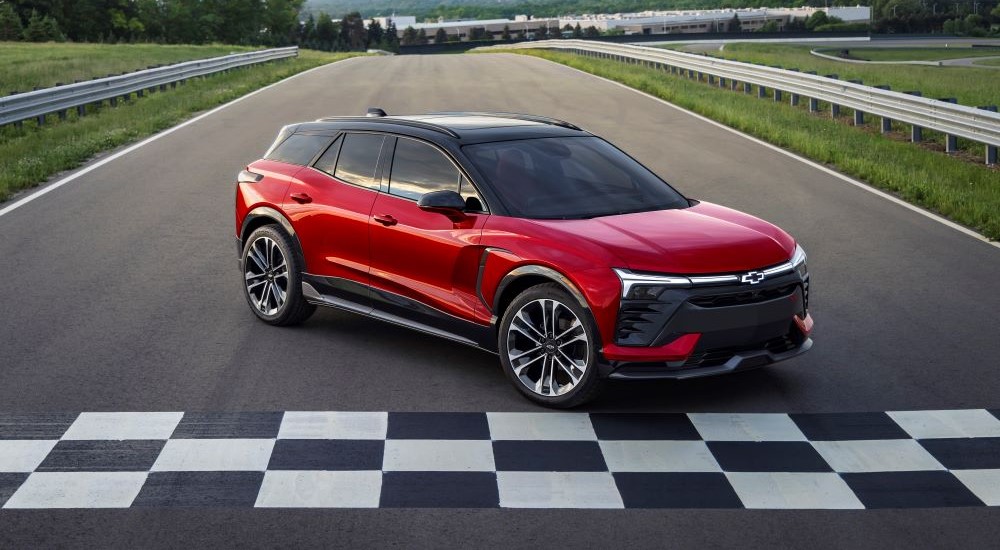
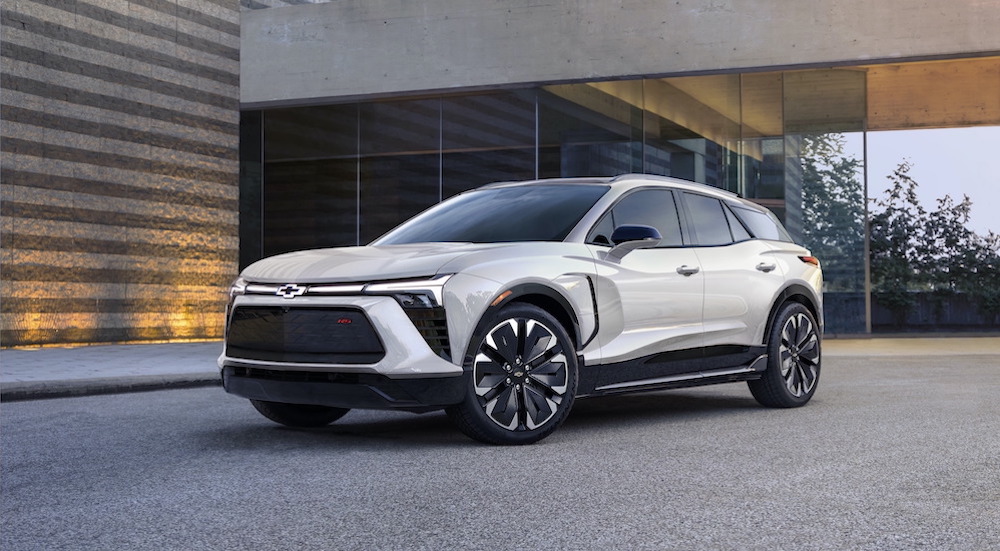
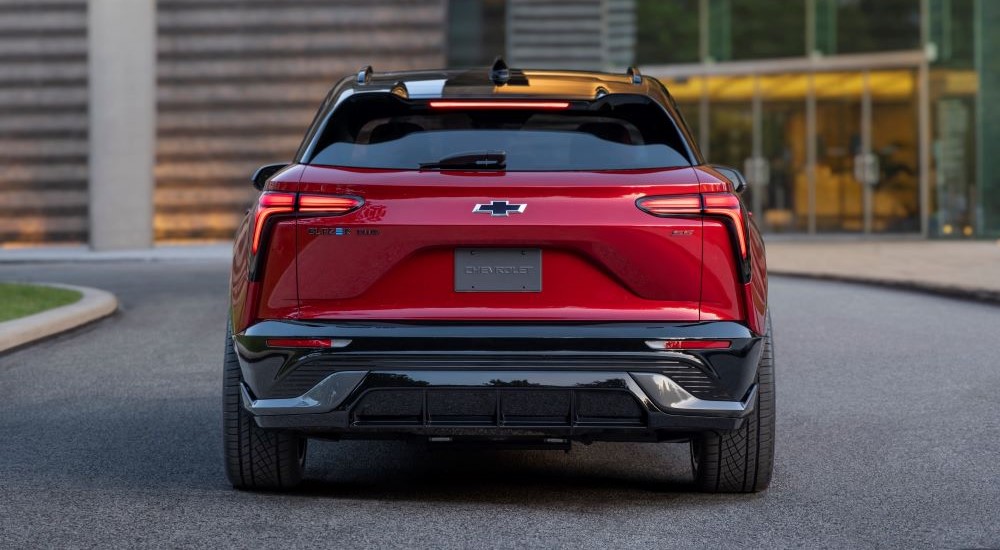
If you were just looking at these two SUVs side by side, you probably wouldn’t guess that they share a platform. Each one has its own distinct style. The Prologue is so understated that it wouldn’t be a stretch to call it bland—the front end is nondescript, the sides don’t have much sculpting, and the overall aesthetic is clean but not exciting. On the other hand, the Blazer EV is inspired by the bold and sporty aesthetic of the gas-powered Blazer and has an aggressive-looking front end with modern, narrow headlights, muscular sculpting on the sides, and an overall look that screams “ready for action.”
One small difference between the two exemplifies how willing each one is to be bold and try new things. Honda’s charging port is located behind a small door that swings open manually, which is practically identical to what you’ll deal with when filling a non-EV Honda up with gas. The Blazer EV, meanwhile, has a more fun and futuristic way to get to the charging point: a panel that blends in with the body nicely when it’s closed and moves up and down electronically when you’re ready to charge.
Powertrain
Both the Blazer and the Prologue are offered with either all-wheel drive or two-wheel drive. Looking at the AWD models, the specs are pretty similar, if not identical. Both EVs use a dual-motor setup powered by an 85 kWh battery, providing 288 horsepower and 333 lb-ft of torque and allowing for up to 1,500 lbs of towing capacity. Thanks to the differences in construction, though, the range figures are a bit different. A Blazer EV with AWD delivers up to 279 miles of range. On the lower-tier EX and Touring trims, the Prologue offers 281 miles of range, but on the top-tier Elite trim, that figure goes down to 273 miles.
Opt for 2WD, and things will get a lot different. Prologue models with FWD use a single motor paired with the same 85 kWh battery, delivering more range (296 miles) but less power (212 hp and 236 lb-ft of torque). Towing capacity remains the same at 1,500 lbs. The Blazer, on the other hand, offers the sporty RS trim with an RWD system that uses a single motor hooked up to a more powerful 102 kWh battery. This delivers more range (324 miles) and more power (340 hp and 325 lb-ft of torque) for a more athletic feel on the road. This setup also raises the Blazer EV’s towing capacity to a more robust 3,500 lbs.
Interior
Step inside, and you’ll find two pretty distinct interior layouts. Some components are shared, but others are quite different. For one thing, take a look at the screens. The Prologue has an 11.3-inch flat central touchscreen and an 11-inch digital gauge display. Meanwhile, the Blazer EV has a similar 11-inch digital gauge display behind the wheel, but a much larger 17.7-inch touchscreen that’s tilted toward the left hand side for a more driver-centric experience.
The Blazer EV is also inspired by Chevy’s history making performance vehicles. The round air vents give the cabin a touch of flair and an available flat-bottom steering wheel not only looks sporty but makes it easier to get in and out of the driver seat. Overall, the look is cohesive and distinct. The Prologue, on the other hand, is a mix of GM components and Honda parts that don’t add up to a whole with any specific personality.
While many buttons and dials are used for both vehicles, there’s one button on the Prologue that you won’t find on the Blazer EV. Honda has opted to use a more traditional push-button start for the Prologue’s ignition. The Blazer EV, on the other hand, is available with Hands-Free Start capabilities. Just enter the cabin with the remote key on your person, and you can get the motor running by closing the driver door or pushing the brake pedal. That means one less button cluttering up the dash and a little added convenience every time you hit the road.
Sticking With the Original Has Its Benefits
The Prologue is a solid option for Honda loyalists who are looking for an EV (in fact, it’s the only option). However, there’s a reason why Honda chose to work with GM to make the Prologue—the Ultium platform used by GM brands like Chevy is top-notch. Chevy has been building vehicles on this platform for years now and has experience making EVs that are reliable, stylish, and fun to drive. Honda’s first attempt isn’t half bad, but it can’t quite match the SUV that it’s based on: the Blazer EV.
Connect with us


- Car Dealership
- Chevy Blazer EV for Sale
- Chevy Blazer for Sale
- Chevy Dealer
- Chevy Dealer Near Ann Arbor
- Chevy Dealer Near Brighton
- Chevy Dealer Near Chelsea
- Chevy Dealer Near Jackson
- Chevy Dealer Near Saline
- Chevy Dealer Near South Lyon
- Chevy Dealer Near Whitmore Lake
- Chevy Dealer Near Ypsilanti
- Chevy Equinox EV for Sale
- Chevy Silverado 1500 for Sale
- Chevy Silverado for Sale
- Chevy Trailblazer for Sale
- Used Car Dealer
- Used Chevy Dealer
- Used Chevy for Sale
- Used SUVs for Sale
- Used Trucks for Sale