





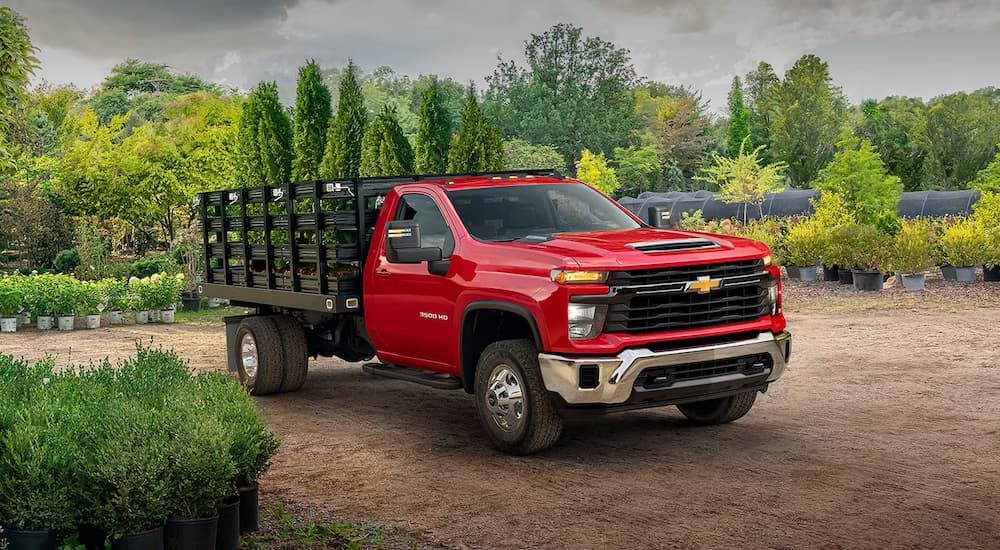
Someone searching for a Chevy Silverado 3500 for sale may need more than a powerful truck with a conventional box bed. Some jobs call for enclosed tool storage, a hydraulic dump body, or an open platform capable of carrying bulky equipment. The 2026 Chevy Silverado 3500 HD Chassis Cab provides the foundation needed to create one of these specialized commercial vehicles.
Contractors, agricultural operations, property-maintenance companies, delivery businesses, and fleet managers can begin with the same heavy-duty chassis and arrive at very different finished trucks. That’s the beauty of the Silverado 3500 HD Chassis Cab! Building the right one involves several connected decisions: gas or diesel power, Regular Cab or Crew Cab, cab-to-axle length, and the type of upfit equipment you need installed.
Payload capacity, combined weight ratings, fuel tank size, and fleet support needs must also be part of the discussion. The objective is not simply to order the most powerful configuration available; it’s to build a 2026 Silverado 3500 HD Chassis Cab around the work your business actually performs. We have much to discuss today, so let’s get a move on because—as any business owner knows—time is money!
Start With the Weight of the Work
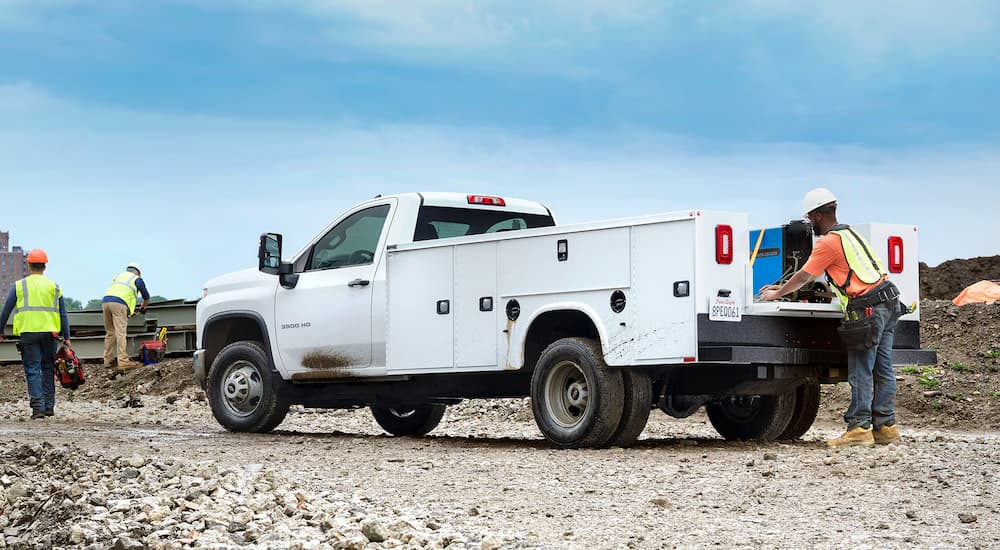
A chassis cab provides the cabin, frame, powertrain, and running gear while leaving the rear body open for specialized equipment—a design that allows you to turn the Silverado 3500 HD into anything you need it to be: a utility truck, dump truck, flatbed, or another vocational vehicle capable of performing tasks a conventional bed box cannot support effectively.
The truck and its upfit should be planned together. An installed body contributes to the vehicle’s total weight, as do tools, supplies, occupants, and other equipment. However, you should also know that GM’s New Vehicle Limited Warranty doesn’t cover equipment or alterations supplied by independent companies, meaning GM is not responsible for their installation, safety, or overall quality; it only covers everything else. Selecting a qualified upfitter is thus an essential step in configuring your truck.
A truck’s Gross Vehicle Weight Rating (GVWR) accounts for its occupants, installed equipment, and cargo, while payload represents the weight your truck can carry. Its Gross Combined Weight Rating (GCWR) considers the combined weight of the truck and its trailer.
The 2026 Silverado 3500 HD Chassis Cab has a maximum available GVWR of 14,000 lbs and a GCWR between 24,000 and 40,000 lbs, with a maximum payload capacity ranging from 6,047 to 7,329 lbs. These measurements show that the Chevy Silverado 3500 HD is ready to handle a variety of responsibilities.
The maximum 7,329-lb payload capacity requires a 2WD Regular Cab, so it doesn’t apply to every configuration. Maximum figures can demonstrate your truck’s potential, but the door-jamb label will be most accurate; this label will identify the vehicle’s true capacity—all upfit equipment considered—so it should guide your real-world loading decisions.
Choose an Engine Based on Intent
Both of the 2026 Silverado 3500 HD Chassis Cab’s engines provide heavy-duty output and pair with a 10-speed Allison automatic transmission. Choosing between these engines should come down to your truck’s expected use rather than the assumption that every business needs the same powertrain.
The standard 6.6L V8 gas engine generates 401 hp and 464 lb-ft of torque. Chevy identifies direct injection, variable valve timing, and a deep-skirt cast-iron engine block among its engineering features.
We’d say this engine is best suited for tasks such as assisting a property-maintenance company, a contractor, or a delivery operation whose truck primarily travels between local job sites. It provides substantial capacity to carry equipment and materials without requiring buyers to choose diesel power when the business does not regularly handle immense loads.
The available 6.6L Duramax Turbo-Diesel V8 increases output to 470 hp and 975 lb-ft of torque. Chevy also equips it with a segment-exclusive air-induction system and variable-geometry turbocharger, as well as an exhaust brake to help you manage a heavily loaded truck or truck-and-trailer combination.
Duramax-equipped models can also be configured with an available large axle featuring a 12-inch ring gear. These qualities may make the diesel engine especially relevant to businesses that tow frequently, travel long distances, or routinely operate with substantial combined weight.
Instead of declaring either engine universally preferable, consider how your truck will spend an ordinary workweek. How much weight will it regularly manage? Will it tow daily or only occasionally? Will it operate locally or cover longer routes? If the installed equipment requires engine-driven auxiliary power, the available Power Take-Off Package may also influence your decision.
Match the Cab and Frame to the Upfit
Cab choice affects both passenger accommodations and the amount of body frame available behind the cab. For businesses that prioritize upfit room or maximum available payload, the Regular Cab may be the logical starting point. Chevy offers it with 60-inch and 84.5-inch cab-to-axle measurements, with the longer option supporting applications that require additional body length.
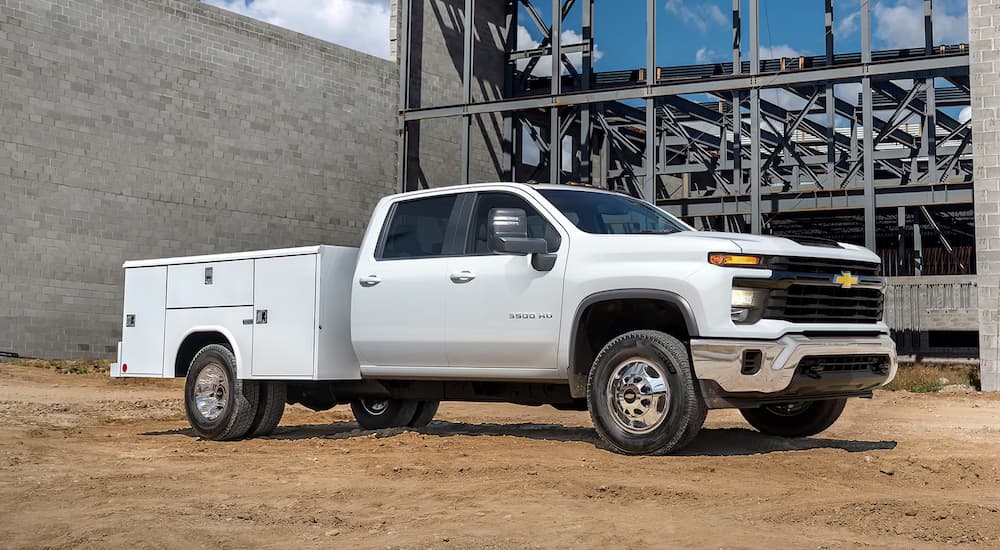
The Crew Cab caters to operations that need to transport several workers between job sites. It uses a 60-inch cab-to-axle measurement and provides 44.5 inches of front legroom. Although it sacrifices some of the layout flexibility associated with the Regular Cab’s longer frame, its additional seating may be essential for a business whose crew and equipment must travel together.
From there, your truck’s intended assignments can point toward the proper upfit. You can take this in several possible directions:
- A utility body can provide organized storage for electricians, plumbers, telecommunications crews, municipal departments, and mobile technicians.
- A dump body may suit landscapers, contractors, farms, and property-maintenance teams moving soil, gravel, mulch, or other loose material.
- A flatbed can give construction companies, agricultural operations, and equipment suppliers an open platform for bulky or irregularly shaped cargo.
Vocational equipment requiring engine-driven auxiliary power may benefit from the available Power Take-Off Package. The 2026 Silverado 3500 HD Chassis Cab also includes a heavy-duty locking rear differential and sturdy 18-inch steel dual-rear-wheel wheels that support its commercial mission.
Whichever body you select, final capability depends on the entire configuration. The chassis, upfit, passengers, tools, cargo, and trailer must all be considered before your truck goes to work!
Plan for Long Days and Busy Routes
A commercial vehicle’s usefulness is not determined entirely by what it can carry. Refueling downtime, driver support, and vehicle oversight can also influence productivity.
Chevy offers two fuel tank options, with an available capacity well over 60 gallons. That larger option is great for agricultural users, rural businesses, and crews that spend long days traveling between distant job sites. Actual driving range will naturally vary with the powertrain, configuration, load, route, and operating conditions.
The Silverado 3500 HD Chassis Cab also offers several technologies intended to assist the driver. These include Following Distance Indicator, Forward Collision Alert, Lane Departure Warning, Automatic Emergency Braking, Front Pedestrian Braking, and IntelliBeam automatic headlights. Such features can provide useful support during long routes, changing traffic conditions, and busy workdays—especially when multiple employees share the same vehicle.
Available OnStar Vehicle Insights can help businesses monitor working vehicles more effectively. It can provide information to support route planning, identify service needs, monitor driver behavior, and enable general fleet oversight. Organized maintenance and operational planning remain essential even when the underlying truck is built for demanding workloads.
What Should You Decide Before Shopping?
Before choosing a 2026 Silverado 3500 HD Chassis Cab, define what the finished vehicle must accomplish by asking…
- What body or equipment will be installed?
- How much will the completed upfit weigh?
- How many people, tools, and materials will the truck carry?
- Will it regularly pull a trailer?
- Will its typical uses favor gas or diesel power?
- Is a Regular Cab sufficient, or must it transport a crew?
- Which cab-to-axle length accommodates the intended body?
- Would the PTO Package or a larger fuel tank help?
Involving our dealership and a qualified upfitter early can help keep those decisions connected. Buyers should also verify the ratings for their exact vehicle rather than relying exclusively on the maximum advertised figures. Configuring a chassis cab is ultimately a business decision, not merely a matter of personal preference.
Turn the Chassis Cab Into a Business Tool
The 2026 Chevy Silverado 3500 HD Chassis Cab is designed to become the truck a particular operation requires. Its gas and diesel V8 engines both pair with 10-speed automatic transmissions, while two cab sizes and varying cab-to-axle lengths allow businesses to create different configurations. Not to mention the freedom to add utility, dump, and flatbed upfits, illustrating only a few ways this model’s impressive GCWR and payload capacity can be put to work.
The most important question is not simply “How powerful is this Silverado?” It’s “How effectively will this truck help support my daily operations?” Commercial shoppers are a special class of consumer, and we believe that every hard worker deserves a vehicle that satisfies their needs.
Connect with us


- Car Dealership
- Chevy Blazer EV for Sale
- Chevy Blazer for Sale
- Chevy Dealer
- Chevy Dealer Near Ann Arbor
- Chevy Dealer Near Brighton
- Chevy Dealer Near Chelsea
- Chevy Dealer Near Jackson
- Chevy Dealer Near Saline
- Chevy Dealer Near South Lyon
- Chevy Dealer Near Whitmore Lake
- Chevy Dealer Near Ypsilanti
- Chevy Equinox EV for Sale
- Chevy Silverado 1500 for Sale
- Chevy Silverado 3500 for Sale
- Chevy Silverado for Sale
- Chevy Trailblazer for Sale
- Tire Shop
- Used Car Dealer
- Used Chevy Dealer
- Used Chevy for Sale
- Used SUVs for Sale
- Used Trucks for Sale